
Custom men’s bomber jackets can be built entirely from your tech pack: shell fabric, lining, rib knit, pockets, zippers, hardware, colours and branding. At SAZ we develop bomber jackets for casual, lifestyle and private label programs, with MOQ starting at 100 pcs per style and colour and sampling confirmed before any bulk cut.
Custom Bomber Jackets OEM
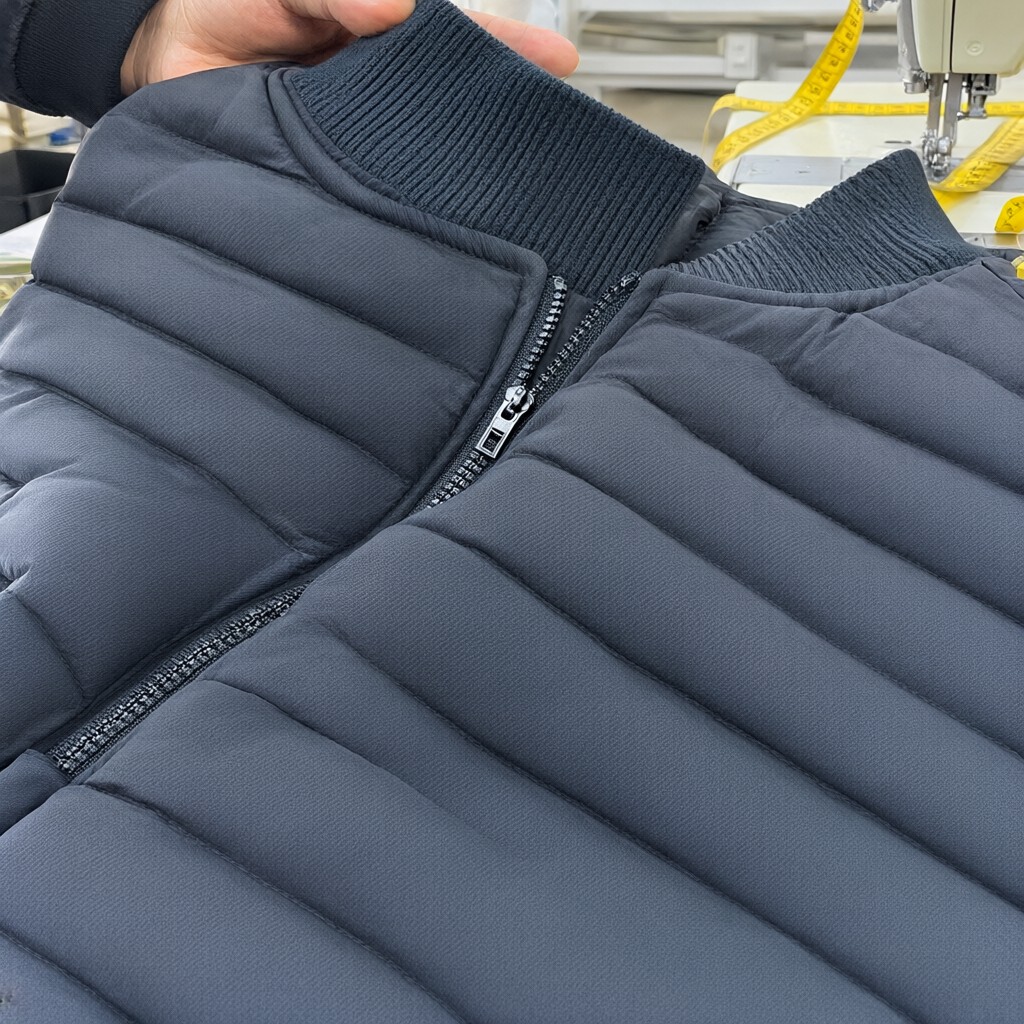
A bomber jacket looks simple. Two sleeves, a zip, three pieces of rib. In practice it is the garment where small errors show loudest — a waistband rib cut half a centimetre short pulls the whole hem out of shape, and you notice it from across the room.
That is why we treat the bomber as a precision job. Every style starts from your documents: a full tech pack, a reference sample, or in some cases just product photos and a measurement chart. Shell fabric, lining, rib content, pocket construction, zipper brand and pullers, colours, labels and packing — all of it is defined before pattern work begins, and re-confirmed on the sealed sample before bulk production starts.
What Goes Into the Technical Specification
Before we quote or cut, we pin down the specification in writing. The items we confirm at this stage:
- Shell fabric: fibre content, weight (GSM), weave and surface finish
- Lining type and insulation, if any
- Rib knit: content, weight, cuff/collar/waistband dimensions
- Zipper type, size and puller; snaps or other hardware
- Pocket construction and placement measurements
- Colourways, Pantone references, branding placement and method
- Care labels, hangtags and packing method
Buyers sometimes arrive without all of these answers. That is fine — we resolve them during sampling. What we will not do is start bulk with an open spec. A vague spec is how a 300-piece order becomes a negotiation.
Shell Fabric and Lining: What Works for a Bomber
The shell decides the character of the garment, so we give it more attention than any other material choice.
Nylon woven fabric. The default for lightweight bombers where you want a smooth, clean surface and a lighter garment weight. It packs down well and reads as a classic MA-1 style.
Polyester woven fabric. Offered in a wide spread of weights, weaves and surface finishes. The choice comes down to the appearance, hand feel and end use you are targeting — a brushed face for autumn streetwear behaves nothing like a crisp taffeta-weight shell for spring.
Durable water-repellent finish. Where light rain resistance matters, a DWR can be applied to suitable shells. We can discuss PFAS-free DWR options during material development, which matters for brands selling into the EU.
Lining and insulation. For spring and transitional programs, a lightweight polyester taffeta lining is usually enough. When the brief calls for warmth and body, a quilted lining adds insulation and thickness. Recycled polyester can be sourced for shell, lining or insulation — and if your order requires GRS documentation, say so before material sourcing begins, because the certified supply chain has to be selected from the start, not retrofitted. Brands working with certified inputs may also want to review OEKO-TEX Standard 100 for the restricted-substances side of the conversation.
The Production Run, Step by Step
How does a custom bomber go from tech pack to carton? Through six stages, each with its own checkpoint:
- Pattern development. We digitize the pattern from your measurements and grading rules, then check it against the reference sample if one exists.
- Fabric inspection and cutting. Fabric is inspected before it reaches the cutting table; panels are cut to the approved pattern.
- Panel sewing and assembly. Main body assembly, sleeve insertion, pocket setting.
- Rib knit and hardware assembly. Collar, cuff and waistband ribs attached; zippers and snaps installed.
- Inline quality inspection. Checks run on the line, not after it — see the section below.
- Final inspection and packing. Finished garments are checked against the sealed sample and measurement sheet, then packed for shipment.
On our floor, the rib stage is where we slow down deliberately. Rib is knitted to spec, and if the gauge or the cut dimension drifts, the hem and cuffs sit wrong on every unit downstream. Better to stop the line for twenty minutes than rework three hundred garments.
What We Check During Production
What actually gets inspected, and when?
Before pattern work, your tech pack or reference sample is reviewed in full — fabric, measurements, rib specification, pockets, zipper and construction details are all confirmed during sampling. Only then does the style move to bulk.
During sewing, the line checks pocket position, zipper alignment and the appearance of the main panel seams. Reinforcement is added at pocket openings and other stress points where the construction calls for it. Collar, cuff and waistband ribs are measured against the approved sample for dimension and attachment quality.
Inline inspection covers stitching, measurements, rib attachment, zipper alignment and colour consistency — shade matching across lots is checked under standard lighting, and a blended lot is visible immediately under the lamp.
Finished garments are verified against the sealed sample and the measurement specification. The final inspection covers appearance, workmanship, measurements and packing before shipment, run to ISO 2859-1 sampling plans at AQL 2.5. If your program needs seam-strength verification to a method such as ASTM D5034, raise it before sampling so it is written into the protocol rather than argued after the fact.
What You Can Customize
Everything that defines the style, frankly. The customization list we work from:
- Shell fabric — nylon or polyester wovens, weight, finish, DWR
- Lining — lightweight taffeta or quilted; recycled options where sourcing allows
- Rib — content, weight, colour and cut dimensions for collar, cuffs, waistband
- Pockets — construction, placement, reinforcement
- Zippers and hardware — type, size, pullers, snaps, metal finish
- Colourways and Pantone matching
- Branding — labels, embroidery, prints, hangtags
- Packing — polybag, carton marks, retail-ready packing
One honest trade-off: the more exotic the fabric or hardware, the longer material development takes and the higher the sampling cost. If your launch date is fixed, lock standard components early and spend your development time on the details buyers actually see.
Sending Us a Tech Pack: What We Need From You
The starting point can be a full tech pack, a reference sample, or a clear design brief. A tech pack is the fastest and cheapest route because it removes questions before they cost money — but we have started plenty of programs from a single sample garment and a measurement chart, and we confirm the main fabric, lining, rib, trims, measurements and branding details with you before sampling begins.
If you have a fabric specification or a reference garment, we can source materials against it during the sampling stage. Bring whatever you have; we will tell you what is missing before it becomes a problem.
Where Are SAZ Bomber Jackets Made, and How Do I Get a Quote?
SAZ garments are produced in our own factory in China, where we run OEM and ODM programs for mens jackets across bomber, puffer, softshell, windbreaker and outdoor styles. We write this from the factory floor: the question buyers ask us most is not about price — it is about what happens when something goes wrong mid-production, and our answer is the checkpoint system above, anchored to a sealed sample and AQL-based final inspection.
To get started, send your tech pack, reference sample or brief to www.saz-cn.com. We review fabric, rib construction, trims, measurements and customization requirements first, then quote sampling. The quote line that always moves last is packing and labels — decide those early and the rest of the negotiation goes faster.
Frequently Asked Questions
What documents do I need to start sampling?
A tech pack is ideal, but a reference sample or a clear design concept also works. Fabric, pattern and construction details are all confirmed during sample development, so you do not need every answer on day one.
Which fabrics are suitable for a custom bomber?
Nylon and polyester woven fabrics are the common shells, chosen by weight, surface appearance, hand feel and season. If you have a reference garment or fabric spec, we source against it during sampling.
Can I get recycled materials with documentation?
Yes. Recycled polyester can be sourced for shell, lining or insulation. If your order needs GRS documentation, tell us before material sourcing so the right certified supply chain is selected.
Can zippers, snaps and trims be customized?
Yes. Pocket construction, zipper type, pullers, snaps and other trims are developed to your design or reference sample, and all of these details are confirmed during sampling before bulk production.
What is the minimum order quantity?
MOQ starts from 100 pcs per style and colour. The final quantity can vary with fabric selection, construction details and customization requirements — pin the MOQ per style and colourway in writing before you commit dates.
Do I need a tech pack to get a quote?
It is the easiest starting point, but a reference sample or measurement chart works too. Before sampling we confirm main fabric, lining, rib, trims, measurements and branding details with you directly.

